Публикацяита Pre-salting in meat се появи първоначално на Zakvaski.bg.
]]>IDEAL SOLUTION TO IMPROVE COLOR FORMATION, COLOR STABILITY AND THE TASTE
Pre-salting is an old technique that was used to protect the meat against spoilage and maintain or even increase the water binding capacity in all the kind of emulsified and cooked products. However there was a huge disadvantage of that solution – the microbiology of the product was out of control.
Still a lot of traditional recipes are based on pre-salting method. Now – thanks to bioprotective cultures – we can make this technology safer. Adding SafePro®B-LC-78 on the top of the product allows us to dominate the background microflora during resting (salting) time. That allows us to reduce significantly random effects of unknown bacteria.
As a result we obtain better color formation and improved color stability. It is worth mentioning that one of the bacteria strain used in that culture – Staphylococci – improves utilization of nitrate and nitrite and in that way reduces peroxides due to catalase production. In that way we get more intensive meat flavor.
There are a few good reasons to reconsider using that method in some of your meat applications. This solution can be used for all kinds of emulsified and cooked products.
The main benefits are:
- more flexibility in buffering fresh meat
- less variations from batch to batch due to better control of the background flora
- improved yield with all natural solution and cost reduction
- potential shelf-life extension, reduction of oxidation while shelf life
- improving color formation and color stability
- food safety – reduction of Listeria monocytogenes risk
- reduction or excluding ”E” numbers
- taste improvement
Публикацяита Pre-salting in meat се появи първоначално на Zakvaski.bg.
]]>Публикацяита Bactoflavor® Flora Italia – with a scent of Italy се появи първоначално на Zakvaski.bg.
]]>Food safety, efficiency and consistent quality! Does this sound familiar?
Well, it does to most salami manufacturers. Most of today’s manufacturers are facing serious challenges as they constantly strive to develop safe and stable products, optimize raw material and manufacturing costs, and provide consumers with appealing products with the right taste, texture and color.
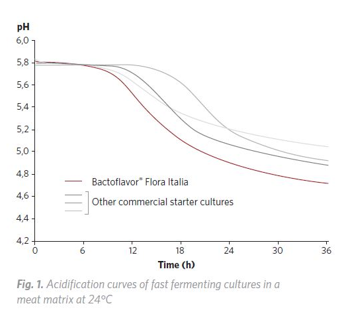
Meat cultures from Chr. Hansen have a long track record of delivering on these aspects and Bactoflavor® Flora Italia is no different. Actually, the extensive scanning of series of strains identified a strain combination that was better than most of the meat cultures presently offered to the meat industry.
Bactoflavor® Flora Italia is characterized by:
- Rapid acidification for a safe production and optimal microbiological quality
- No compromise on color and aroma thanks to the very active and pH resistant Staphylococci strains
- Robustness that securing repeatability,regardless of the raw material quality
- A new L. sakei strain meeting the consumer demands for sweeter and non-spicy flavor notes, which are so typical of the smooth Italian products
Now Chr. Hansen also launches SafePro® Flora Italia LC to provide an extra food safety barrier to minimize the risk of Listeria monocytogenes growth.
Публикацяита Bactoflavor® Flora Italia – with a scent of Italy се появи първоначално на Zakvaski.bg.
]]>Публикацяита Food trends: meat consumption up, beef declines се появи първоначално на Zakvaski.bg.
]]>Global meat consumption has recorded a year-on-year increase when compared to figures from 2014, according to data from London-based market intelligence firm Euromonitor International.
Meat consumption going up is hardly a surprise; as the global population continues to expand, numerous analysts have predicted meat consumption will rise as it keeps pace with a more populous Planet Earth. However, beef and veal consumption, specifically, has declined in most of the parts of the developed, post-industrial world.
Beef and veal consumption by volume fell by 3% in the US last year, when compared to figures from 2014 Euromonitor data highlights. In 2014, the US consumed 8,003.40 tonnes (t) of beef and veal, this number fell to 7,753.80t last year.
Consumption of beef and veal receded on 2014 levels in Australasia, Europe and South America, but experienced growth in the Middle East, Africa and the Asia-Pacific regions.
Red meat health fears
“On a global level, overall meat consumption grew by 2% in volume in 2015,” said Anastasia Alieva, head of fresh food research at Euromonitor International. “Demand for meat has been driven by emerging markets, where increased prosperity and rising populations resulted in a growing consumption of relatively expensive meat. The MEA [Middle East and Africa] and Asia-Pacific performed most dynamically recording growth of 4% and 3% respectively and were the only two regions where beef and veal recorded growth.”
One of the reason beef and veal consumption had declined across Europe could be linked to consumer fears over the negative health effects associated with red meat consumption.
At the same time, in Western Europe, meat in general and beef and veal in particular continued to decline by 0.3% and 1% respectively amidst mounting health concerns linking red meat to cardiovascular disorders and colon cancer.
Source: globalmeatnews.com
Публикацяита Food trends: meat consumption up, beef declines се появи първоначално на Zakvaski.bg.
]]>Публикацяита Bactoferm® meat starter cultures се появи първоначално на Zakvaski.bg.
]]>
Making consumers try your product is a result of numerous impressions and personal preferences. For consumers to buy again they must have had a positive experience – to keep buying requires that they get what they expect again and again. Our Bactoferm® meat cultures offer:
Consistent quality
To provide consistent quality day in and day out you need to be in control but Who controls the background flora of so-called artisanal salami? NOBODY!! Only by adding high levels of natural but standardized strains can the background flora be suppressed and the variability from uncontrolled fermentation eliminated.
Control of the process
Using Bactoferm® is about gaining control – it is a range of fermentation cultures that are tailor-made from natural but standardized strains to deliver constant product quality batch after batch in a cost efficient manner. Today’s starter cultures are isolated from meat and salami products e.g. from Italy.
Appealing appearance
As consumers, we often buy with our eyes, i.e. we pick products that look appealing to us. Bactoferm® adds positively to the appearance by facilitating the attractive red color.
Excellent taste
Obviously, flavor is a key attribute and a fundamental reason for repurchase. Bactoferm® cultures – alive and natural – are among the main contributors to salami flavor, particularly, when no dominant spices are used.
Right texture
Texture is one of the most important quality parameters to the consumer as well as the producer. Be it soft or be it hard; it has to be consistent.
Yield
Is important in most operations and closely related to texture and degree of drying. When your process is under control it is possible to optimize for yield and quality adding to the bottom line.
Food safety
It is the responsibility of food manufacturers to produce and market products that are safe and fit to be consumed i.e. unspoiled and not conveying illness. Bactoferm® plays a key role in these efforts by acidifying the meat batter and easing the drying process.
Easy to use
Starter cultures require no change in process –actually you can expect to reach the final product much faster than depending on any background flora.
Beneficial molds
Molds are traditionally used in some products and totally unacceptable in others. For whole salamis they do support texture, more traditional flavor, pH control and absence of aflatoxins – if commercial molds are applied. The Bactoferm® range includes molds.
Brand Protection
Bactoferm® is also about brand protection i.e. the consumers get what they want and expect –all the time – a basis for growth.
Proven technology
The worldwide inoculation of salami practiced since 1960 has confirmed the good results achieved by the combination of elements of the traditional technology and the standardized starter cultures. This has eliminated most of the variation stemming from uncontrollable and potentially dangerous background flora. The many years of inoculation have as well helped to create new technologies that are safer and more efficient.
Simple Labeling
Fermentation cultures are generally labeled as “starter culture”. This labeling has in general a positive marketing effect and is often used also where labeling of cultures is not compulsory. Local authorities must always be consulted.
Sustainability
Food waste is a growing concern to the public and an ethical problem in a world where food scarcity exists and will most likely grow. Adding Bactoferm® for consistent quality, minimal waste and improved food safety makes sense to society, too.
Публикацяита Bactoferm® meat starter cultures се появи първоначално на Zakvaski.bg.
]]>With the fast-fermenting cultures from Chr. Hansen you can reduce the risk and expect...
Публикацяита Starter cultures for fast fermentation се появи първоначално на Zakvaski.bg.
]]>Meat cultures play a key role for the safety of fermented sausages as they are responsible for the fermentation and subsequently increased drying of the sausages.
With the starter cultures for fast fermentation from Chr. Hansen you can reduce the risk and expect:
- Rapid decline in the pH values
- Same quality
- Safe products
- Higher productivity
- Lower energy costs
- Improved efficiency
Fermentation starter cultures for fast fermentation are based on lactic acid bacteria with high suppressive abilities on the one hand and a moderate lactic acid formation on the other. In addition, the outstanding strains Staphylococcus provide good and stable color and rich authentic taste.
For more information about products in this category you can contact Chr. Hansen‘s representative in Bulgaria:
eng. Dejan Ristov, dkdri@chr-hansen.com 
or us:
office@admix.bg, tel.: +359 2 938 51 05 
Публикацяита Starter cultures for fast fermentation се появи първоначално на Zakvaski.bg.
]]>Chr. Hansen traditional starter cultures are specifically selected and are suitable for both traditional South European sausages and the sausages, typical of North Europe.
Публикацяита Starter cultures for tranditional fermentation се появи първоначално на Zakvaski.bg.
]]> The use of Chr. Hansen’s starter cultures for meat provides production of always the same meat products and a high level of food safety. The starter cultures eliminate the influence of uncontrolled local flora and ensure the desired quality from batch to batch. Starter cultures for tranditional fermentation.
Chr. Hansen traditional starter cultures are specifically selected and are suitable for both traditional South European sausages and the sausages, typical of North Europe.
For more information about products in this category you can contact Chr. Hansen’s representative in Bulgaria:
eng. Dejan Ristov, dkdri@chr-hansen.com
or us:
office@admix.bg, tel.: +359 2 938 51 05
Публикацяита Starter cultures for tranditional fermentation се появи първоначално на Zakvaski.bg.
]]>